Connect the Lines: From Experiment to Exhibition
The exhibition Edvard Munch: Connect the Lines is the result of a years-long process of experimentation, collaboration and trial-and-error. This article looks back at this process and how it developed artificial intelligence (AI) as a tool for getting closer to Munch’s drawings.
A Disconnected Collection
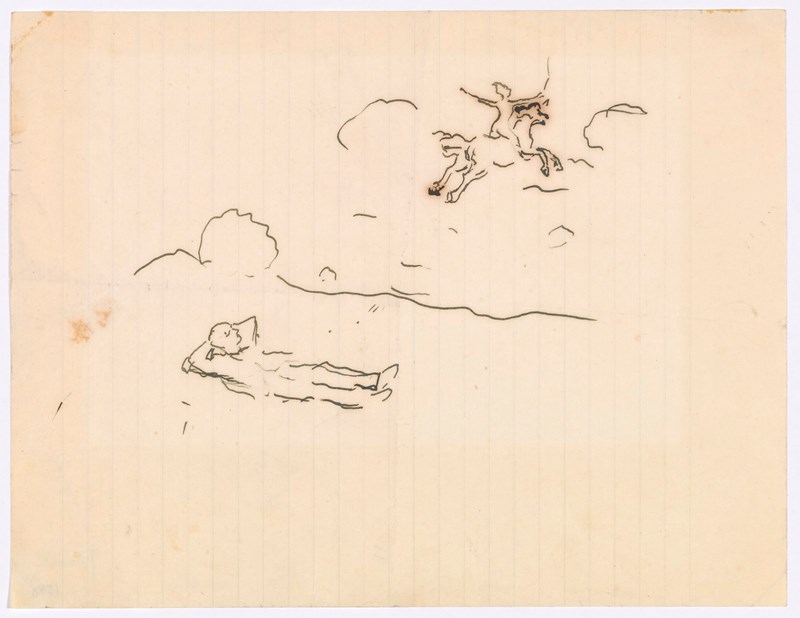
To see the around 7,000 drawings by the Norwegian artist Edvard Munch (1863-1944) that are kept in the MUNCH Museum’s archive is an amazing experience. Since Munch rarely threw away what he created, his drawings include everything: doodles, rough sketches, childhood drawings, caricatures, quickly captured impressions, as well as large-scale masterpieces in delicate colours and assured linework. Drawing accompanied Munch throughout his life. To draw was a way of thinking for him, a method to experiment and develop new motifs, and an intuitive and readily accessible tool to capture the world. Arguably, there is no other means of expression that brings us as intimately close to Munch’s experimental artistic practice as his drawings. To see his drawings is to be in the artist’s presence.
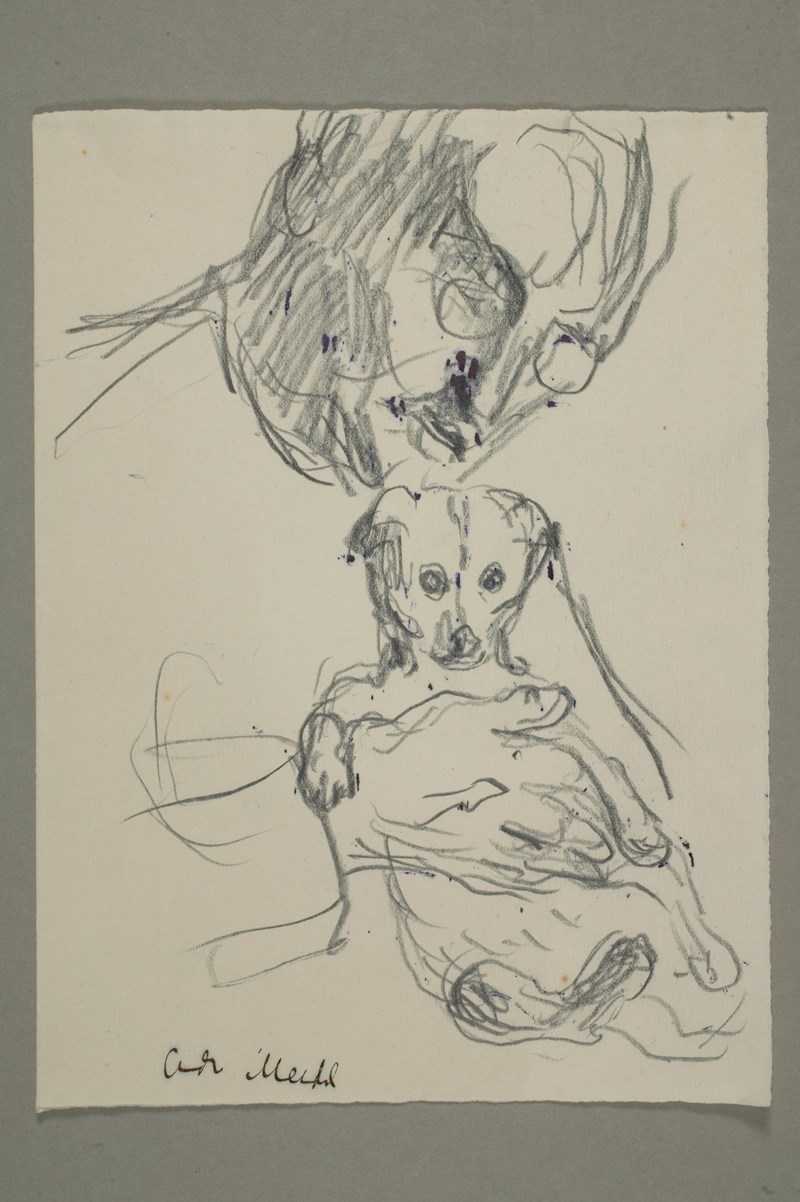
Unfortunately, the experience of Munch’s drawings is paved with obstacles and challenges. Drawn on paper, these museum objects are extremely light sensitive, which makes it difficult to exhibit them regularly over longer periods of time. And many of them are in such bad shape that they nearly shouldn’t be exhibited at all. On the one hand, the museum is responsible for preserving Munch’s work for future generations. Yet on the other hand, MUNCH is a public museum with the societal mission to share Edvard Munch’s art with as many people as possible. This creates a dilemma – and a productive challenge: How can we make Edvard Munch’s drawings broadly accessible, while at the same time taking care of these fragile museum objects?
Digital Connectivity
A potential solution to the challenge stated above lies in the media revolution of digitisation, which has remade the world we live in for the last decades. Museums – slowly-moving and conservative organisations (as they literally conserve the past) – have not been left unaffected by digitisation and digital culture. In the case of MUNCH, the digitisation of its collections has been a monumental task for the last twenty years, resulting in the creation of digital twins of thousands of paintings, graphic prints, drawings, sculptures, photographs and texts, in addition to exhibition documentation, research material and collection records.
Facing the task of making accessible Munch’s drawings, the team of MUNCH Lab – the museum’s experimental space for visitor experiences – started to pay attention to their digital twins in around 2022. After all, these digital versions of the drawings are immune to the weaknesses of their original sources: they are virtually indestructible, withstand any exhibition setting or form of visitor interaction and can be indefinitely reproduced on any digital interface. Then again, many past museum attempts to create digital visitor experiences based on their collections – some of ours included – have fallen short in terms of quality and integrity. So, when we initiated the MUNCH Lab project New Snow, we knew we had to tread very carefully.
Latent Disconnects
The initial idea for New Snow was to explore drawing as a means to playfully connect with Munch’s drawings. In the early stages, we envisioned a drawing interface that would immediately respond to an analogue user drawing on physical paper. The user draws a line, the system responds with a line – using a style and content based on Munch’s drawings. To this end, we started exploring the artificial intelligence (AI) model GAN (Generative Adversarial Network). These first steps were taken in collaboration with the artist group Random International and interaction design PhD candidate Christian Sivertsen from the IT University of Copenhagen.
The prototype realisation of the idea of a highly responsive drawing interaction made us aware of a fundamental problem we faced as an art museum institution in using AI. AI imaging models, such as the GAN model we used, operate in a latent space, between data points and between images. This is a general aspect of AI that we, as a society, have become much more aware of when generative AI imaging models stepped onto the world stage in the last years. The potential scenario of new AI-generated Munch works forced the team and MUNCH to reflect more broadly what these new artificial image creators meant for the cultural heritage sector.
New Snow Connections
MUNCH started a research collaboration with the international, India-rooted technology company Tata Consultancy Services (TCS) in 2023. A deliberate decision was taken against the use of generative AI that would enable the user to prompt the creation of new images in the style of Munch. Instead, we pursued the development of a drawing interaction so basic we were unsure if it would work: the user creates a digital drawing on a tablet, presses the search button, and the system finds a few Munch drawings matching the user drawing.
For New Snow I, the first public prototype showcased at MUNCH Lab, the search engine was based on two small open-source AI models; one to identify patterns in the user drawing and the other to generate short descriptions of it to improve the accuracy of the match. Even though the search results often felt random and imprecise for users, New Snow I confirmed the potential of the interaction. In the two-and-a-half months of its runtime, 59,379 user drawings were created and 1,814 Munch drawings discovered.
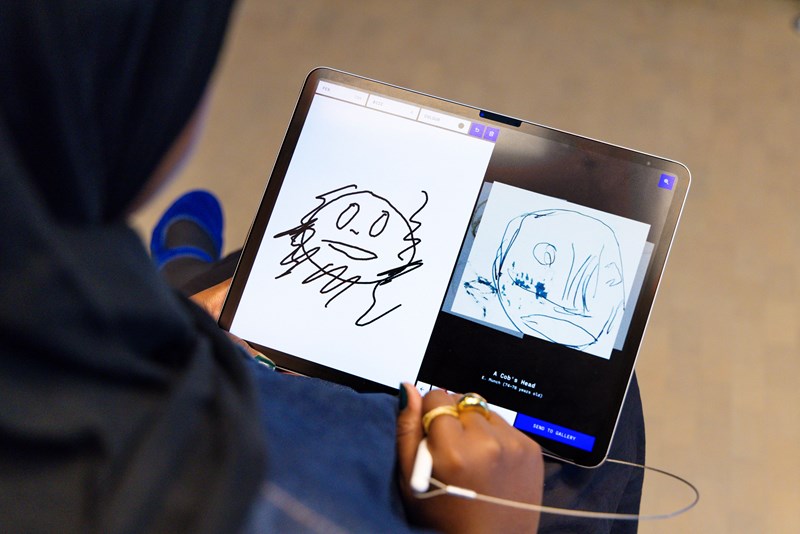
Photo: Ove Kvavik, Munchmuseet
For the next iteration, New Snow II, TCS and MUNCH pivoted from open-source models to a well-known commercial agentic AI – OpenAI’s GPT. This important change resulted in significantly improved matches between user drawings and Munch drawings and an overall more satisfying experience. Yet using GPT also created ethical challenges, especially in terms of what happens to user data. While not being able to solve these challenges, it was important for the team to be as open and transparent as possible about them. New Snow II ran for five weeks, resulting in 21,230 user drawings and 2,996 discovered Munch drawings – a success story that pointed towards an upscaled iteration.
In 2025, New Snow was greenlighted to become an exhibition, eventually titled Edvard Munch: Connect the Lines. TCS continued improving the search engine, still based on OpenAI’s GPT. The new system analyses the user drawing in terms of what it looks like (its lines, shapes and composition) and what it seems to portray. By combining these two interpretations, the system finds drawings in the archives that are similar to the user drawing – both visually and thematically.
Having become an exhibition proper, 25 original drawings by Edvard Munch were chosen to be displayed – their selection very much based on what had fascinated users about Munch’s drawings in New Snow I and II: their strangeness, spontaneity and unexpectedness. While the MUNCH Lab iterations of New Snow featured no more than six to eight tablets, the exhibition is to have around 30 tablets in use simultaneously. With this, the exhibition is the biggest iteration yet of what once started as a small innovation project, and a significant exploration of the potentials and pitfalls of AI-driven museum experiences for MUNCH.
The enormous pace of AI development is a source of anxiety for many; and the technology – besides its benefits – has already proven to be a tool for spreading misinformation and division. We believe that art can be an antidote to this and that AI – used responsibly – can play a role in connecting museums with their communities. In the development process that led to the Connect the Lines exhibition, AI has grown into a substantial tool to bring visitors closer to Edvard Munch’s drawings sheltered in the museum archive.


