Provenance Research at MUNCH
As a museum, MUNCH has a responsibility to ensure the best possible knowledge of the artworks in our collections.
In addition to its physical appearance, an object’s identity includes non-physical aspects, for example the history of its owner(s), termed provenance. A traceable line of ownership, ideally from the object’s point of creation up until the present, helps to place the object into its correct historical context, and thus affects the way in how an object can be interpreted beyond its visual appearance.
At the same time, the provenance of an object can also help to establish its authenticity as well as the rightfulness of its ownership(s). With regard to the latter, the aspect of rightfulness does not only include valid laws, but also international ethical principles as lined out in the Washington Principles (1998), the declarations of Vilnius (2000) and Terezin (2009), and the Best Practices for the Washington Conference Principles (2024), which find application when the change of ownership of an object took place during the Nazi period 1933-1945. Since 1998, these principles and guidelines have substantially shaped the approach towards provenance research within the professional art world. An increasing number of art institutions wish to take full responsibility for their collections, and therefore dedicate the required resources needed for this kind of interdisciplinary and time-consuming field of research.
The Munch Museum is the custodian of four art collections, owned by the City of Oslo: The Edvard Munch Collection, the Ludvig Ravensberg Collection, the Amaldus Nielsen Collection and the Rolf E. Stenersen Collection. The first three come directly from the respective artists’ estates and therefore have an essentially unproblematic provenance. In contrast, the Stenersen Collection holds the works by various Norwegian artists, including Edvard Munch, which Rolf E. Stenersen bought both directly from the artists as well as on the open art market.
Rolf E. Stenersen donated his collection to Aker municipality, later Oslo municipality, in 1936. The collection came without clear provenance details or acquisition documentation. The gift to Aker municipality was made under the condition that a home would be built for the collection. When this did not happen, Stenersen continued partially to manage the collection until his death, which included amendments to the collection.
We acknowledge that a thorough and systematic review of the entire Stenersen Collection has not been carried out since the collection catalogue was compiled by Arne Eggum in 1974. Though, general provenance research has been conducted on the paintings by Edvard Munch in the Stenersen Collection for the catalogue raisonné Edvard Munch: Complete Paintings, vols.1-4, published in Norwegian i 2008 and English in 2009.
Prompted by an enquiry made by the German law firm Von Trott zu Solz Lammek regarding the provenance of Edvard Munch’s painting History in the Stenersen Collection (Stenersen Collection RES.A.315; Woll M 1099), in late 2024 the museum established a designated Provenance Task Force, consisting of five museum employees. The task of the provenance research team has been to research the provenance of History, as well as to identify other artworks in the Munch Museum’s collections with a potentially problematic provenance. At the same time, the museum appointed an independent Ethics Committee on Provenance (operative since May 2025), an autonomous advisory board that advises the museum on the handling of provenance cases in accordance with the ethical principles of the 1998 Washington Principles and subsequent international declarations.
Until now, the museum has identified four paintings with potentially problematic provenance in the Stenersen Collection. While the case of History could be concluded in May 2026, the three other works are still subject of further research. The following list gives an overview of the works and their current provenance status:
Works with clarified provenance
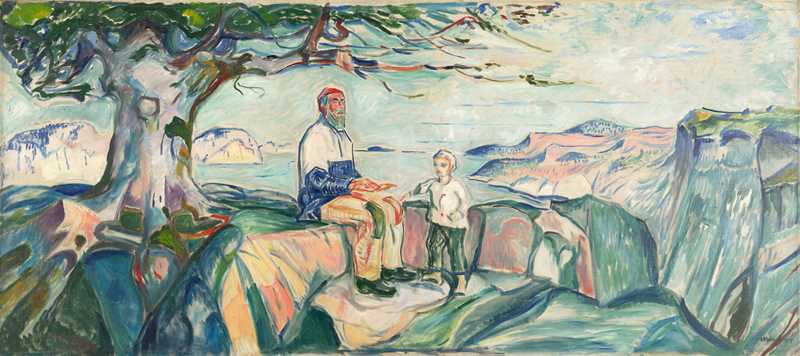
Edvard Munch, History, 1913, Oil on canvas. Photo: Halvor Bjørngård, Munchmuseet
RES.A.00315: Edvard Munch, History, 1914 (Woll M 1099)
This work was acquired by the Jewish art collectors Martin and Florence Flersheim (Frankfurt am Main) prior May 1917. Martin Flersheim died in 1935, and his widow fled in June 1938 from the escalating antisemitism in Nazi-Germany, first to Amsterdam, then to the USA. Amongst the moving goods, which she was allowed to have sent after her in December 1938, was most of her art collection, including this painting. In January 1939, it was given into commission to Cassirer Gallery Amsterdam. The Gallery arranged for this painting to be transported to Norway, where it appeared twice at the art market in Oslo: first it was offered at City Auksjon (19.1.1939), then again at Blomqvist Kunsthandel (9.3.1939). The details of these sales could not be reconstructed, but we know that Rolf E. Stenersen must have acquired the work before 1946, when it was exhibited as part of the Stenersen Collection in Sweden.
After the Munch Museum had been approached by a law firm representing the heirs after Florence Flersheim, a designated task force researched the provenance of this work thoroughly from December 2024 to February 2026. All findings were scrutinized by MUNCH’s independent Ethics Committee for Provenance. Based on the current knowledge and the committee’s recommendation, the City of Oslo (as owner of the Stenersen Collection) concluded that there are no sufficient grounds to classify the sale of History in 1939 as involuntary, and that therefore the work is not to be restituted to the heirs.
For the complete research report, see here (link to PDF).
Works with potentially problematic provenance
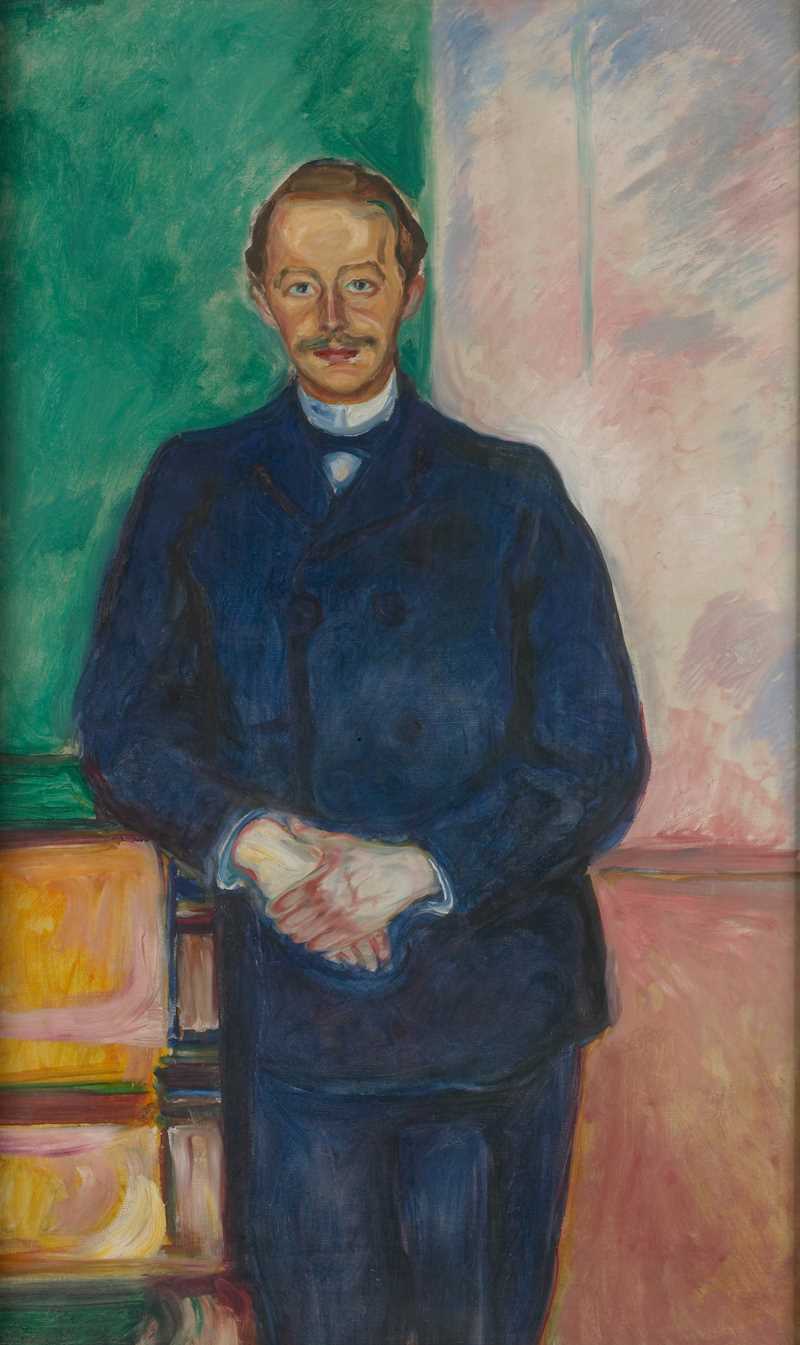
Edvard Munch, Max Linde in Sailing Outfit, 1904, Oil on canvas. Foto: Richard Jeffries, Munchmuseet
RES.A.00074: Edvard Munch, Max Linde in Sailing Outfit, 1904 (Woll M 619)
This work was owned by the German art collector Max Linde until 1925. We don’t know when it came to the Städtische Museum in Breslau (today Wrocław in Western Poland), where it was confiscated by the German state in 1938. The work was then purchased by the Norwegian art dealer Harald Holst Halvorsen and later by Rolf E. Stenersen. We do not know the circumstances of Halvorsen’s acquisition and the subsequent sale. We know that Stenersen must have acquired it before 1946, when the work was first exhibited under his name. No ownership claims have been made for this work.
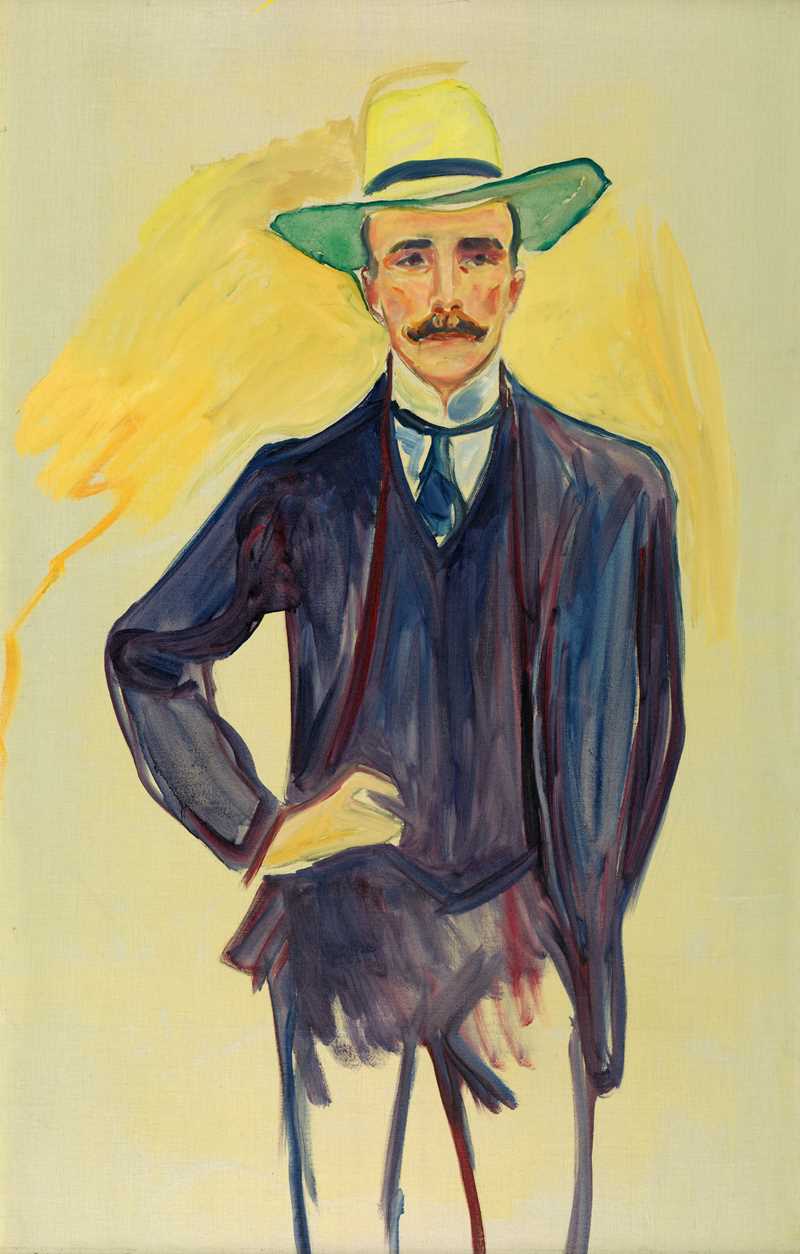
Edvard Munch, Harry Graf Kessler, 1906, Oil on canvas. Photo: Ove Kvavik, Munchmuseet
RES.A.00219: Edvard Munch, Harry Graf Kessler, 1906 (Woll M 695)
We have no information regarding previous owner(s) of this work. The work was offered at City Auksjon in Oslo on 19.1.1939, an auction which included various artworks by Edvard Munch from German collections, including History (see above). We do not know when exactly Stenersen acquired this work, but it must have been before 1950, when the work was first exhibited under his name. No ownership claims have been made for this work.
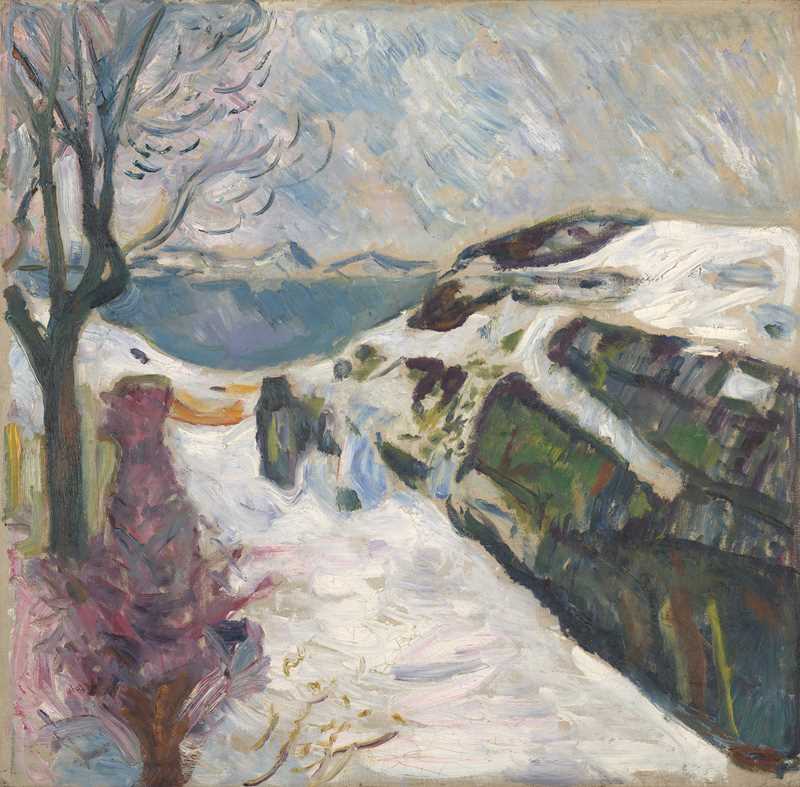
Edvard Munch, Winter Landscape from Kragerø, 1910, Oil on canvas. Photo: Halvor Bjørngård, Munchmuseet
RES.A.00012: Edvard Munch, Winter Landscape from Kragerø, 1910 (Woll M 887)
This work was purchased by the Jewish collector Alfred Flechtheim in 1912 and sold at auction in 1917 to an unknown buyer. We know that it was exhibited in Leipzig in 1929, then in private ownership in Hamburg. By 1936, the work had become part of the Rolf E. Stenersen’s collection. However, we have no information regarding the previous owner nor the circumstances of Stenersen’s acquisition. No ownership claims have been made for this work.
We acknowledge that there may be further works in the collection with potentially problematic provenance. In the case of new findings, the above list will be updated accordingly.
If you wish to share any relevant information with us, please do not hesitate to contact Director of Collections Caroline Ugelstad (link to email address).


