Where can you see Edvard Munch in Oslo?
If you want to see the art of Edvard Munch in Oslo, there are two main museums to visit: MUNCH and Nasjonalmuseet.
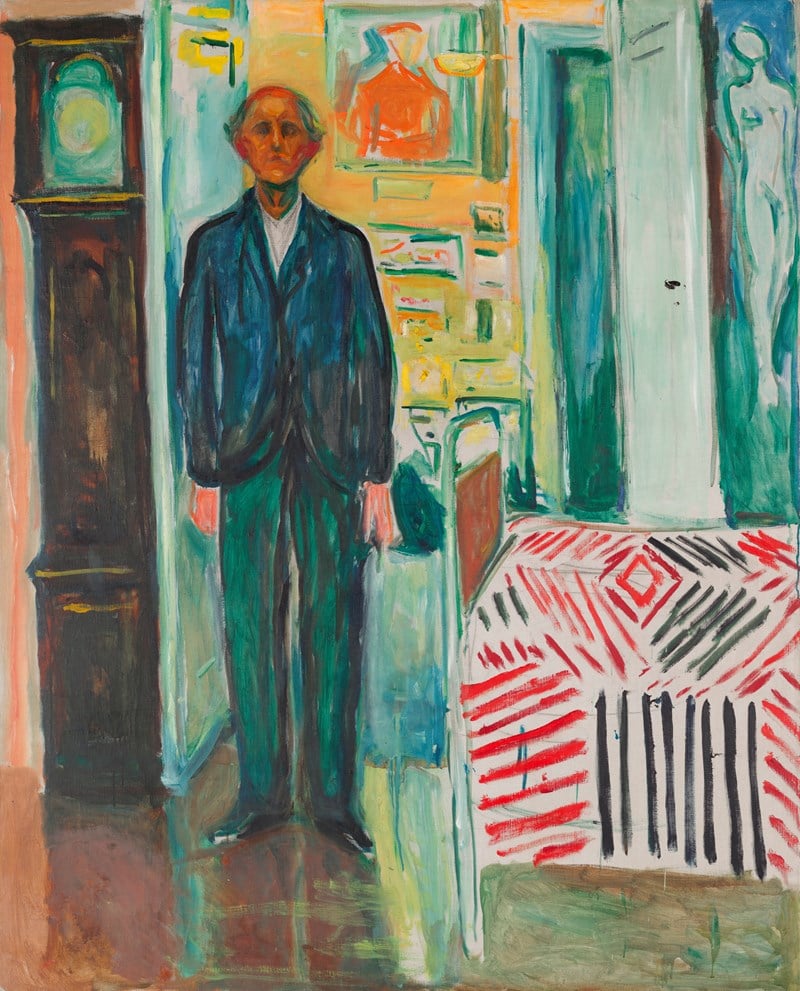
Edvard Munch, Self-Portrait. Between the Clock and the Bed, 1940-43, oil on canvas. Photo: Halvor Bjørngård, Munchmuseet
Both museums hold important works by Munch, including versions of his most famous painting, The Scream. Visiting both museums offers a deeper understanding of one of Norway’s most influential artists.
Why are Munch’s works in two museums?
During his lifetime, many of Edvard Munch’s most well-known paintings were acquired by the National Museum.
When Munch died in 1944, he left the rest of his artistic estate to the City of Oslo. This extraordinary donation included thousands of paintings, prints, drawings, photographs and personal objects. The collection became the foundation of the Munch Museum, which today is known as MUNCH.
Because of this history, some of Munch’s most famous paintings are held by the National Museum, while the vast majority of his works are preserved and presented at MUNCH.
How many Munch works can you see?
At the National Museum, visitors can see 18 key works by Edvard Munch in the museum’s dedicated Munch Room.
At MUNCH, nearly 200 works by Edvard Munch are on display at any given time across five collection exhibitions. This allows visitors to explore the breadth of his artistic career, from early experiments to late works.
In the exhibition Infinite alone, visitors can experience around 130 works by Munch, and the selection changes throughout the year.
Can you see The Scream in both museums?
Yes. Both museums display famous works by Munch, including versions of The Scream, The Dance of Life, The Sick Child, Madonna and The Girls on the Bridge.
This is because Edvard Munch often created several versions of the same motif. When he sold a painting, he frequently painted another version that he kept himself.
Different ways to experience Munch
At the National Museum, Munch’s paintings are presented alongside works by other artists, placing his art within a broader art-historical context.
At MUNCH, visitors can explore the full range of Edvard Munch’s artistic experimentation. Dedicated exhibitions present his paintings, prints, drawings and large-scale works, offering a deeper insight into his creative process.
For example, the exhibition Up Close explores how Munch worked with woodcuts, while Monumental presents some of his largest paintings, measuring up to 50 square metres. In the exhibition Horizons, visitors can also discover the artistic environment that shaped Munch during the years he developed as an artist.


